

Thursday, February 20, 2014
Love Your Pet Day
The month of February, seems to be all about love, and our pets are no exceptions. Today is Love Your Pet Day! Give a special treat for your pet or just some extra cuddle time today. We also share in your love for your pets!

Thursday, January 23, 2014
Tuesday, November 5, 2013
Pets and Garbage
If your pet’s nose goes in the trash on a regular basis, be extra careful during the holidays! The trash will be extra interesting when filled with holiday scraps, but it will also be more dangerous. Keep those garbage can lids on tight!


Wednesday, September 18, 2013
Wednesday, August 14, 2013
Make Sure They Can Get Home: Check Your Pet's Microchip
.jpg)
Is your pet's microchip up-to-date? If your pet were lost,
would an animal hospital or shelter be able to contact you once your pet was
found?
It's important to
get your pet microchipped; but it's just as important to make sure that
microchip contains the correct information in order for your four-legged friend
to get home.
That's why the American Animal Hospital
Association (AAHA) and the American Veterinary Medical Association (AVMA) are
teaming up to encourage pet owners to update their pet's microchip information
on National Check the Chip Day, Aug. 15.
Almost 9.6 million pets are euthanized every
year because their owners can't be found, according to the American Humane
Association. While tags and collars are important, microchipping is a valuable
method because the microchip won't wear out, tear, slip off or become lost.
How does a microchip work?
The microchip, which is about the size of a grain of rice, is injected by a veterinarian or veterinary technician just beneath your pet's skin in the area between the shoulder blades. This is usually done without anesthesia, and the experience can be compared to getting a vaccination.
The microchip, which is about the size of a grain of rice, is injected by a veterinarian or veterinary technician just beneath your pet's skin in the area between the shoulder blades. This is usually done without anesthesia, and the experience can be compared to getting a vaccination.
Each microchip has a unique registration
number that is entered into a database or registry, and is associated with your
name and contact information. If your lost dog or cat is found by an animal
hospital, shelter or humane society, they will use a microchip scanner to read
the number and contact the registry to get your information.
Make sure you can be found, too
While it may be comforting to know the microchip won't get lost or damaged, and that it will probably last the pet's lifetime, the microchip is useless if you're not updating your contact information with the registry. If your pet has been microchipped, keep the documentation paperwork so you can find the contact information for the registry. If you don't have the documentation paperwork, contact the veterinarian or shelter where the chip was implanted.
While it may be comforting to know the microchip won't get lost or damaged, and that it will probably last the pet's lifetime, the microchip is useless if you're not updating your contact information with the registry. If your pet has been microchipped, keep the documentation paperwork so you can find the contact information for the registry. If you don't have the documentation paperwork, contact the veterinarian or shelter where the chip was implanted.
Keep in mind there are more than a dozen
companies that maintain databases of chip ID numbers in the U.S. By using
AAHA's Universal Pet Microchip Lookup at petmicrochiplookup.org, you can locate the registry for your chip
by entering the microchip ID number. If you don't have your pet's microchip ID
number, have a veterinarian scan it and give it to you.
Only about 17% of lost dogs and 2% of lost
cats ever find their way back to their owners. Prevent the heartache and ensure
your pet has an up-to-date microchip.
Originally published by Healthy
Pet.
Monday, July 8, 2013
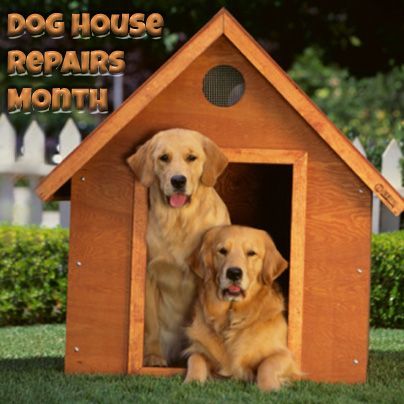
Dog House Repairs Month
Does your dog have his or her own house? It's Dog House Repairs Month! Make sure that it’s in good shape this summer! Check the interior corners for beehives, and make sure to repair leaks and splinters in the wood.

Tuesday, June 4, 2013
Pet Appreciation Week
This week is Pet Appreciation Week, a time set aside for pet owners to show their pets how much they mean to them. Are you doing anything special for your pet this week?


Subscribe to:
Posts (Atom)